The Best AI Tools to Turn Any Story Into a Film or Series (2026): 11 Tested and Paid For
You have a story to tell. A brand series your customers follow, a lesson your students remember, a training your team actually watches, or a short film. AI video can make it now, but most tools make you pay for every guess on the way, so you spend hours and a lot of money before you see anything close to what you imagined.
We build Mythreel, so we tested the other tools ourselves, with our own money, in October 2026: the same kind of story in each, one to three minutes, and we wrote down what we paid for every finished minute. Here is what we found, honestly, including where others are better.
What makes an AI story video tool good
- It gets the story right before it spends. Does it ask about your story, or guess from one line and start charging?
- You see it before you pay. Can you look at the cast, the scenes and the shots, and change them, before a single clip is filmed?
- Changes are easy and cheap. When one thing is wrong, can you fix just that, and does the rest of the story follow?
- The price of a finished minute, retakes included, not the price on the plan page.
At a glance
| Tool | Best for | See before you pay | Price per finished minute (our test) |
|---|---|---|---|
| Mythreel | Marketers, educators, trainers and storytellers who want exactly the film or series they have in mind | Yes: story, cast, every shot and its lines, free | $16–24 in Full HD; first episode free |
| OpenArt | Creators who want an editor for every shot | Partly, once you ask for the editor | $31 (720p) |
| pixo | A quick script-to-screen draft | Assets and storyboard, yes | $101 (1080p) |
| Higgsfield | The best-looking single shots | No storyboard or timeline | $111 (Cinema Studio) |
| Flick | Professional filmmakers and studios | Yes: story doc, canvas, 3D blocking | Not measured yet ($45 plan) |
| Artlist Studio | Consistent looks within a scene | First look only | Not measured |
| PlotParty | Tinkerers who like a canvas and a file tree | Cost upfront, little story | $24.50 (720p) |
| Buzzy | YouTube creators | A plan card, no pictures | $32 (768p) |
| Topview | YouTube and social videos | Same as Buzzy | Same as Buzzy |
| Deevid | Single clips with many video models | Not a story tool | Not measured |
| LongStories | Long animated stories at low resolution | Paywall before the storyboard | Plans from $59 a month |
On average, Mythreel costs about 3x less per finished minute than what we paid at the five story tools we measured, and it is in Full HD where most of them gave us 720p. Then there's what the table can't show: with Mythreel you don't pay for guesses, because you see and fix the story before anything is filmed.
Who it's for: anyone with a story to tell
- Marketers: tell your brand or product as a series people follow, episode after episode, not a one-off ad. For example, a founder's story in five episodes.
- Educators: turn a lesson into scenes with characters your students remember. For example, a history chapter told by the people who lived it.
- Trainers and instructors: role-play the moments your team has to get right. For example, how to calm an angry customer, or a safety walk-through on the shop floor.
- Storytellers: the short film or series you've had in your head for years.
Whatever the story, the hard part is the same: getting the video you meant, without paying for every guess. That is what we compared.
1. Mythreel: the best tool to tell a story as a film or series
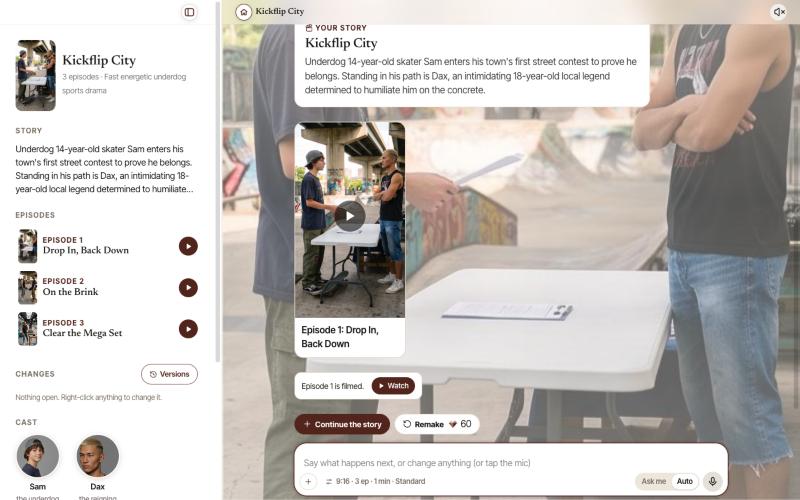
Every other tool we tried rushes to filming and charges you to find out what it guessed. Mythreel takes you step by step, at your pace, and you only pay for what you already know you want.
- It starts with your story. Tell it the idea, paste an outline, or drop in a whole story. It asks only what your story still lacks, in plain words, and why it matters. Or say "just make it" and it decides for you.
- See everything before you pay. The whole story, every episode with a picture, every face and place, and every shot with who says what: all free to look at and to change. Only filming costs credits.
- Change it once, and everything follows. Say what's wrong, or right-click it. Mythreel finds every scene the change touches, in this episode and the ones after it, tells you before it does anything, and films again only the seconds that change. You don't have to think about what else needs fixing; it does. Earlier versions stay, to play again for free.
- Fast, smooth and easy to find your way around. One chat and one panel. No timeline, no model names, no prompts to write. You talk about your story, by text or voice, and watch it come together scene by scene.
- A film or a series, for any purpose. A campaign, a course, a training or a show: a film of up to 10 minutes, or up to 20 episodes of 30 seconds to 3 minutes, vertical or wide, with spoken dialogue, music and captions.
- The price. Your first episode is free. After that $16–24 a minute in Full HD, about a third of what the others cost us on average.
Because you see and correct the story before it's filmed, what comes out is much closer to what you imagined, and you get there in a fraction of the time and money.
2. OpenArt: best for a shot-by-shot editor
- What it does well: fine control through chat, and a real editor: per shot you can recreate, modify, extend, upscale or dub; per scene you can add and reorder shots; character and world sheets you can edit.
- The catch: the editor only appears when you ask the assistant for it, and it didn't work for us the first time. Before that, everything is buried in the chat behind one loading screen. You pick the language model yourself, and the whole film is paid upfront, not episode by episode. It was the most expensive tool in our test overall ($94 with top-ups).
3. pixo: best for a quick script-to-screen draft
- What it does well: it proposes characters, locations, objects and a style guide upfront, fills script, assets, storyboard and timeline side by side, and has a draggable storyboard with a preview per scene.
- The catch: it never asks about your story and leaves decisions open. You only see the cost when you ask. It shows raw model names and technical internals, and we hit many errors. At $101 per finished minute, it was one of the most expensive.
4. Higgsfield: best for the best-looking single shots
- What it does well: the best generation quality we saw, by far, and a character sheet for every character in Cinema Studio.
- The catch: there is no storyboard or timeline, so you can't see or reorder your scenes, and it decides things for you from generic input. In Cinema Studio we paid €64 for about 40 seconds, several clips failed, and the script was nowhere to be found afterwards. Great shots, but you build the story yourself.
5. Flick: best for professional filmmakers
- What it does well: storyboarding the way a real studio does it. Each stage has its own space: the story in a document, the visuals on a canvas, the blocking on a 3D stage, and a video editor to cut it together. Deep character tools, and a review step you control.
- The catch: it's built for professional teams, so there is a lot to learn before your first scene. We haven't filmed with it yet.
6. Artlist Studio: best for consistency within a scene
- What it does well: a beautiful interface, and a flow focused on keeping looks consistent inside a scene.
- The catch: less about storytelling or building a world across scenes and episodes. This is a first look; we haven't filmed with it yet.
7. PlotParty: best for tinkerers
- What it does well: setup asks for style, aspect ratio, length and model, and shows the cost upfront. A canvas with many tools (360° panoramas, character views, a 3D director console), and a file tree for deep control.
- The catch: a cluttered canvas, weak story planning that got our characters wrong, and no advice on format or length. It rushes to filming every clip at once, and consistency across shots was poor.
8. Buzzy: best for YouTube creators
- What it does well: a fun brainstorm with a director agent, a plan card you approve (credits, scenes, format, length, style), and a workspace in clear steps through to thumbnails and publishing.
- The catch: no character sheets or pictures before filming, and scenes can only be redone all at once. Our six clips (37 seconds) used up all our credits, had no audio and weren't consistent.
9. Topview: best for social videos
- What it does well and the catch: in our test it worked the same way as Buzzy, with the same strengths and the same limits.
10. Deevid: best for single clips from many models
- What it does well: one subscription for many video models, plus ad, avatar and music tools.
- The catch: it's a clip generator, not a story tool: there is no cast, story or storyboard that carries across scenes. We haven't filmed with it ourselves.
11. LongStories: best for long, simple animated stories
- What it does well: it takes an idea, a script or audio, and sets duration, voices, format and captions upfront. It is honest about what its basic 480p animation looks like.
- The catch: you hit a paywall before seeing anything (a one-minute storyboard costs 164 credits plus a plan, from $59 a month), so we never got to an output.
Which one should you pick?
- You're a marketer, educator, trainer or storyteller and want exactly the film or series you have in mind, quickly and affordably: Mythreel.
- You want to edit every shot by hand: OpenArt.
- You want the most beautiful single shots and will build the story yourself: Higgsfield.
- You are a professional filmmaker or studio: Flick.
- You make YouTube videos: Buzzy or Topview.
Frequently Asked Questions (FAQ)
What is the best AI tool to turn a story into a video?
Whether it's a brand series, a lesson, a training or a short film, Mythreel, if you want exactly the video you have in mind without learning a video tool: it shapes the story with you, shows you the whole story, the cast and every shot before you pay, and fixes everything a change touches. If you want the best-looking single shots and are happy to assemble the story yourself, Higgsfield. If you are a professional filmmaker who wants a full studio workflow, Flick.
How much does an AI short film cost?
In our tests, the story tools cost between $24 and $111 for every finished minute, most of them at 720p, and every retake was paid again. Mythreel costs $16 to $24 a minute in Full HD (1080p), the story, pictures and changes before filming are free, and your first episode is free.
Can I use AI story videos for marketing, teaching or training?
Yes. A story with characters holds attention better than a talking head or a slide: a brand told as a series, a lesson told by the people in it, a training scenario your team lives through. Mythreel makes each as a film or a series of short episodes, vertical for social or wide for a screen.
Can I change one scene without remaking the whole video?
In most tools you regenerate the clip, or the whole scene, and pay for it again. In Mythreel you say what to change, or right-click it: it finds every scene the change touches, in this episode and later ones, shows you the new picture and lines for free if you want, and films again only the seconds that change. Earlier versions stay, to play again for free.
Can AI keep characters consistent across scenes and episodes?
Yes, when the tool makes a sheet for each character and each place before filming and uses it in every shot. Mythreel does this for every project, and you can see and change each face before anything is filmed.
Do I need video editing or prompting skills?
Not with Mythreel. There is no timeline, no model to pick and no prompt to write: you talk about your story in plain words, or with your voice, and it does the rest.
The fastest way to know is to try it with your own story. Start on Mythreel: tell it your idea, see the whole story and its cast for free, and your first episode is on us.